
Learn how to identify and control the Early Shoot Borer in crops. Our guide covers damage symptoms, ETL, and effective management strategies for farmers.
Table of Contents
Early Shoot Borer: Chilo infuscatellus (Crambidae: Lepidoptera)
The Early Shoot Borer is a significant agricultural pest found across India, Pakistan, Indonesia, Thailand, the Philippines, Korea, Afghanistan, and Burma. While it is a primary threat to sugarcane, its host range also includes pearl millet, oat, barley, and maize.
Damage Symptoms and Identification
In the early stages of the crop, this insect is a significant pest. The most prominent sign of infestation is the “dead heart” in 1-3 month old crops. This straw-colored dead heart can be readily plucked out and often emanates an unpleasant odour from the decaying component. Upon closer inspection at the base of the shoot, just above the ground surface, several bore holes are typically visible.
Economic Threshold Level (ETL)
Effective management should begin when the population reaches an ETL of 15% dead heart infestation.

Bionomics of Chilo infuscatellus
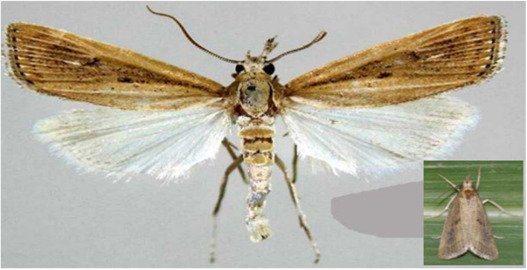
The larva is characterized by a dark brown head and five dark violet longitudinal stripes on a filthy white body. The adult is a light grayish-brown moth featuring black spots at the forewing costae and distinct white hind wings.
Integrated Management Strategies
Use management techniques if there is an excess ETL of 15% dead hearts in the population. Following these cultural and chemical practices can mitigate crop loss:
- Resistant Cultivars: Plant CO 312, CO 421, CO 661, CO 917, and CO 853.
- Time of Planting: Planting in December – January helps the crop escape the peak incidence period.
- Trash Mulching: Apply a 10 to 15 cm thick layer of mulch on the third day following planting.
- Earthing Up: Perform earthing up on day thirty of the crop cycle.
- Moisture Control: Ensure the field maintains sufficient moisture levels.
- Mechanical Control: Manually take out and burn dead hearts to reduce the pest population.
Chemical Control for Early Shoot Borer
For chemical intervention, the following soil and row treatments are recommended:
- At Planting: Before the cane setts are covered, apply carbofuran 3G @ 33 kg or fipronil 0.3 G at 25.0-33.0 kg/ha to the soil.
- Post-Planting: 45 days after planting, apply cartap hydrochloride 4G or fipronil 0.3 G at 25 kg per ha. This should be combined with 50 kg of soil and sprinkled along the rows before earthing up.