
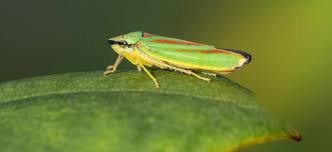
Master Leafhopper (Amrasca devastans) control in cotton and vegetable crops. Learn to identify hopper burn symptoms, ETL, and effective management strategies
Table of Contents
Leafhopper: Amrasca devastans (Cicadellidae: Hemiptera)
The Leafhopper is a serious pest throughout India’s cotton-growing regions. This highly adaptive insect maintains an extensive host range, frequently attacking crops such as cotton, potatoes, brinjals, castor, bhendi (okra), tomatoes, hollyhocks, and sunflowers.
Damage Symptoms and “Hopper Burn” Identification
Both nymphs and adults ingest the sap from the underside of leaves, leading to severe physiological stress for the plant. Early signs of infestation include fragile leaves that become yellow and curl downward at the margins.
As the Leafhopper population increases, the foliage becomes reddened. In cases of a strong infestation, the leaves turn a classic “hopper burn” color of bronze or brick red. Consequently, affected crops grow more slowly, leading to significant yield loss.
Economic Threshold Level (ETL)
Intervention is required when the population reaches the ETL:
- 50 nymphs or adults are found for every 50 leaves (1 per leaf).
- 25 percent of the field’s plants show fading and curling in their middle to upper portions.
Bionomics of Amrasca devastans
Adults are green, wedge-shaped insects that lay eggs singly within the leaf veins. After a 4- to 11-day incubation period, translucent, light-green nymphs emerge. These nymphs reside on the underside of leaves between the veins and undergo five moults over 7–21 days. The total life cycle ranges from 15 to 46 days, with up to eleven generations recorded per year.
Integrated Management Strategies
Effective Leafhopper management requires a combination of cultural, biological, and chemical tactics:
- Cultural Practices: Infestation is decreased by early sowing and close spacing, particularly during periods of heavy rainfall.
- Resistant Varieties: Planting adaptable and hardy varieties such as MCU 3, MCU 5, and MCU 9 is highly recommended.
- Monitoring: Set up a light trap to draw in and destroy adults while keeping an eye on their broods.
- Biological Control: Release the predator Chrysopa carnea (Green Lacewing) to naturally reduce nymph populations.
- Chemical Application: If ETL is exceeded, spray:
- Monocrotophos 36 WSC @ 1000 ml/ha
- NSKE (Neem Seed Kernel Extract) 5 percent @ 25 kg/ha
- Endosulfan 35 EC @ 750 ml/ha