
Learn to identify and manage the Top Borer (Scirpophaga excerptalis). Discover damage symptoms, bionomics, and effective biological control methods for your crop.
Table of Contents
Top Borer: Scirpophaga excerptalis (Pyralidae: Lepidoptera)
The Top Borer is a significant agricultural pest widely distributed across Asia, including Formosa, Japan, the Philippines, Thailand, Bangladesh, Indonesia, Laos, Cambodia, Vietnam, Burma, and Taiwan. Its host range primarily includes various grasses, millets, and other related plant species.
Damage Symptoms and Identification
Infestation by this pest causes distinct physical changes in the plant architecture. Farmers can identify the presence of the larvae through the following signs:
- Dead Hearts: In mature canes, these appear in a reddish-brown color and are notoriously difficult to pull apart.
- Shot Holes: Parallel rows of small holes appear in the emerging leaves.
- Midrib Tunnels: Red tunnels are often visible in the midribs of the leaves.
- Bunchy Top: The development of side shoots leads to a “bunchy top” appearance.
The larva typically initiates damage by boring through the midrib of unfurled leaves and mining its way down to the base.
Bionomics of Scirpophaga excerptalis
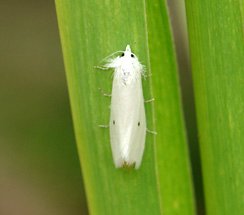
The Top Borer larva is smooth and white or cream in color, featuring a yellow head and a characteristic red middorsal line. The adult moth is white; notably, the female possesses a buff-colored anal tuft at the abdominal tip, which is a key identifying feature.
Integrated Management Strategies
To effectively control the pest population and minimize crop loss, the following integrated management practices are recommended:
- Resistant Strains: Grow proven resistant cultivars such as Co 724, CoJ 67, Co 1158, and Co 1111.
- Mechanical Control: Regularly gather and eliminate egg masses found on the foliage.
- Biological Control: Release specific biocontrol agents to target various life stages:
- Prepupal Parasitoids: Isotima javensis (ichneumonid parasitoid) at 100 pairs per hectare.
- Egg Parasitoids: Telenomus beneficiens, Tetrastichus schoenobi, Trichogramma chilonis, Goniozus indicus, Chelonus sp., and Tetrastichus ayyari.
Chemical Control for Severe Infestations
When biological methods are insufficient, chemical intervention can be utilized. To treat the infestation, spray 1000 L of water mixed with 18.5 SC of chlorantraniprole per hectare.